 DialerGiants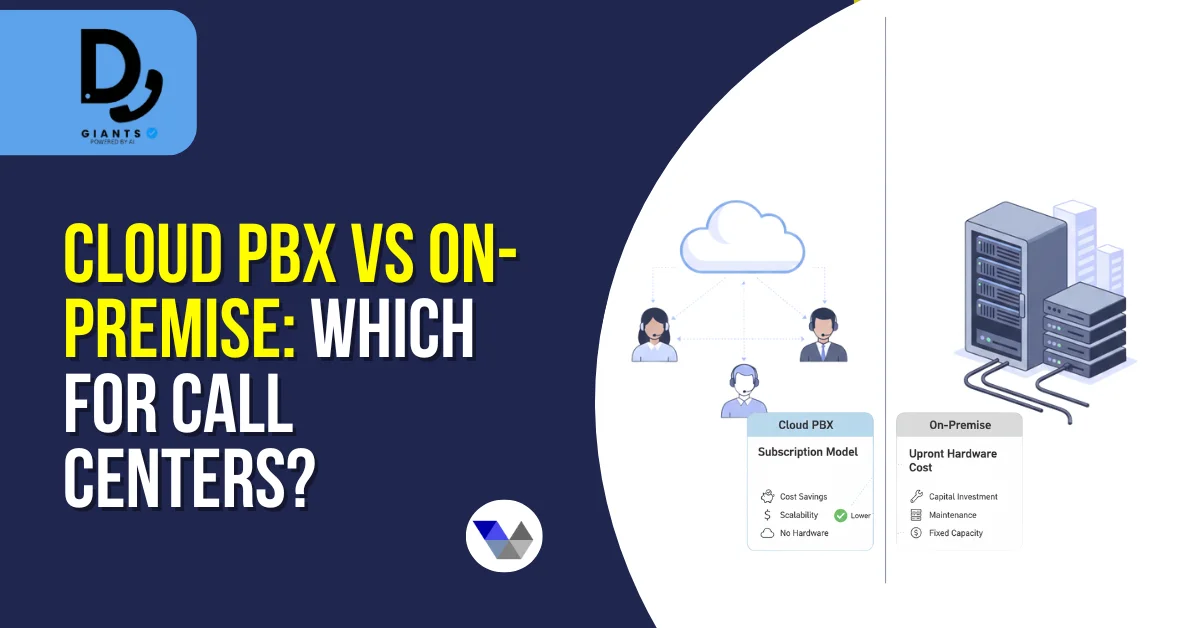
Quick definitions — what each option means
What is Cloud PBX?
A cloud PBX (hosted PBX) runs in a provider's datacenter or public cloud. The vendor manages telephony servers, software updates, and infrastructure. Call centers access the system over the internet or private links. Cloud contact centers often bundle omnichannel routing, analytics, and workforce tools.
What is On-Premise PBX?
An on-premise PBX is installed and operated within your data center or office premises. Your IT team owns servers, manages upgrades, and handles integrations. On-premise setups offer deep customization and direct control of voice paths and call records.
Head-to-head: core comparison factors
Cost model — CAPEX vs OPEX
- Cloud PBX: Typically operating expense (OPEX). Pay per seat per month, avoid heavy up-front hardware costs. Includes software, maintenance, and often trunking options.
- On-Premise PBX: Up-front capital expenditure (CAPEX) for servers, SBCs, gateways, and licenses. Ongoing costs include power, cooling, skilled staff, and hardware replacement.
Deployment speed and flexibility
- Cloud PBX: Fast deployment—often days or weeks. Add seats or features quickly. Ideal for rapid scaling, seasonal spikes, or multi-site rollouts.
- On-Premise PBX: Deployment can take weeks to months due to hardware setup, network configuration, and PSTN interconnects.
Scalability and elasticity
- Cloud PBX: Highly elastic—scale up or down instantly. Useful for unpredictable call volumes and remote agents.
- On-Premise PBX: Scaling requires additional hardware and capacity planning. Elasticity limited by procurement cycles.
Performance and call quality
- Cloud PBX: Call quality depends on internet connectivity and provider network. QoS and local breakout POPs mitigate latency.
- On-Premise PBX: Often offers lower latency and consistent QoS within local network. Good where ultra-low jitter is critical.
Control and customization
- Cloud PBX: Configuration through provider portals; deep customizations may be constrained. Some vendors offer APIs.
- On-Premise PBX: Full control over dialplan, routing, integrations, and data handling. Better for bespoke workflows.
Reliability and redundancy
- Cloud PBX: Provider-managed redundancy across sites ensures failover, SLA-backed uptime.
- On-Premise PBX: Reliability depends on your architecture; redundant servers and carrier diversity can match cloud resilience.
Security and compliance
- Cloud PBX: Reputable providers invest in security controls, SOC audits, encryption, compliance certifications.
- On-Premise PBX: Offers physical control of data and logs—preferred for regulated industries with strict data residency.
Management and skills
- Cloud PBX: Less internal management; vendor handles upgrades and patching. IT focuses on user management.
- On-Premise PBX: Requires in-house telephony, network, and security expertise. Patching is your responsibility.
Real-world cost considerations
- Seat-based monthly fees (cloud) vs up-front hardware/licenses (on-premise)
- SIP trunk costs and PSTN breakout charges
- Network upgrades for redundant internet links and QoS
- Staffing costs for in-house support vs managed services fees
- Recording storage costs and retention policies
Use cases — which option fits which scenario?
Choose Cloud PBX if:
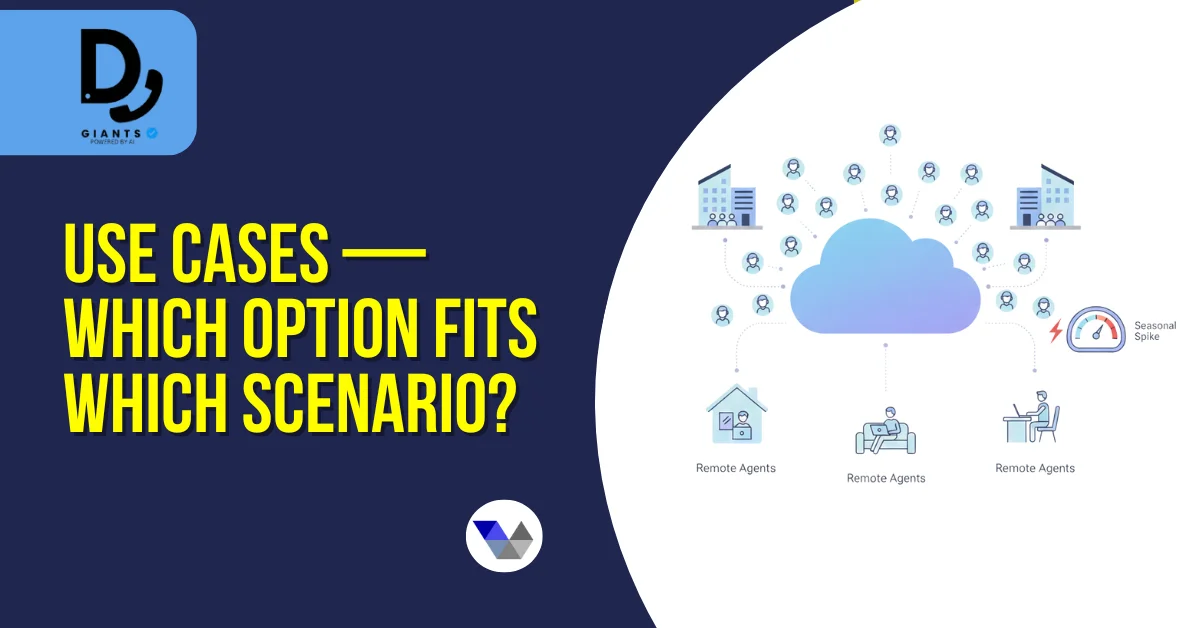
- You run multiple locations or remote/hybrid agents
- You need to scale rapidly for seasonal campaigns
- You prefer predictable OPEX budgeting
- You want fast deployment and managed services
- You value integrated cloud analytics, AI, and omnichannel features
Choose On-Premise PBX if:
- Your call center handles highly sensitive data requiring strict data residency
- You need deep customization and legacy system integrations
- You have skilled telephony staff and want direct control over voice paths
- Your call volumes are extremely high and predictable, making CAPEX attractive
Consider Hybrid or Co-Managed Models
Many enterprises choose hybrid: core telephony on-premise with cloud-based analytics or trunking. Co-managed models let you keep sensitive workloads in-house while leveraging cloud for scalability and DR.
Technical checklist — what to verify before deciding
- Network readiness: Internet bandwidth, SLA, jitter and packet loss metrics
- Redundancy plan: Secondary internet links and carrier diversity
- Compliance needs: Data residency, PCI, HIPAA, GDPR requirements
- Integration needs: CRM, WFM, recording, and custom middleware
- Provider SLAs: Uptime guarantees, support SLAs, incident response times
- Migration plan: Number porting, dialplan mapping, and cutover strategy
- Cost model: Seat costs, trunking fees, recording storage, surge pricing
Migration and implementation best practices
- Pilot first: Start with a controlled pilot to validate call quality and integrations
- Staged migration: Move non-critical campaigns to test trunking and routing
- Training: Prepare agents and supervisors for new dashboards and workflows
- Fallback procedures: Maintain backup PSTN numbers during cutover
- Monitoring: Implement real-time monitoring for MOS, jitter, and packet loss
Vendor selection tips for cloud PBX
- Verify regional PoP coverage to minimize latency
- Ask for enterprise-level SLAs and documented incident histories
- Check API availability for CRM and automation
- Evaluate security certifications and data segregation policies
- Test reporting and WFM integration during trial periods
- Review exit and data export terms to avoid vendor lock-in
Security considerations — detailed view
- Encryption: TLS for signaling and SRTP for media where possible
- Authentication: Strong SIP authentication; rotate keys regularly
- Network security: SBCs, restrict SIP ports to known peers, VLANs for voice
- Monitoring & logging: Centralize logs and enable anomaly detection for toll fraud
- Access controls: Limit admin UI access by IP and use MFA for cloud portals

Future trends affecting the choice
- Edge PoPs and local breakout make cloud PBX even more reliable globally
- AI-driven routing and speech analytics are becoming standard cloud features
- 5G and private LTE reduce latency for mobile and remote agents, favoring cloud adoption
- SIP trunk consolidation and global carriers bundled with cloud PBX simplify international calling
Quick decision flow — which to pick in 3 questions
- Is fast time-to-market and easy scaling your priority? → Cloud PBX
- Do you require full data control and heavy customization? → On-Premise PBX
- Do you need a mix of both? → Evaluate hybrid or co-managed solutions
FAQs
Which is more cost-effective for call centers: Cloud PBX or On-Premise PBX?
Cloud PBX is generally more cost-effective for small to medium call centers because it uses a monthly subscription model and does not require heavy upfront hardware investment. On-premise PBX may be cheaper long-term for large call centers with thousands of agents and predictable workloads.
Is cloud PBX reliable enough for high-volume call centers?
Yes—modern cloud PBX platforms use geo-redundant data centers and SLA-backed uptime. As long as the call center has stable internet and QoS policies, cloud systems can deliver excellent reliability.
Can I customize call flows and integrations more easily with on-premise PBX?
Yes. On-premise PBX provides full control over dial plans, routing logic, database integrations, and custom middleware. Cloud PBX offers configuration options and APIs, but deep customization may be limited depending on the vendor.
What option is better for remote or hybrid call center teams?
Cloud PBX is typically the best choice for remote teams because agents can connect from anywhere using the internet or softphones. Scaling new remote seats is fast and does not require local hardware installation.
Can a call center use both cloud PBX and on-premise PBX together?
Yes. Many organizations adopt a hybrid model—keeping mission-critical or sensitive workloads on-premise while using cloud PBX for scalability, analytics, and disaster recovery. This approach allows flexibility and cost optimization.
Conclusion
Both cloud PBX and on-premise PBX can power effective call centers. The right choice depends on your organization's priorities: cost model, speed of deployment, control needs, compliance demands, and scale. In 2025, cloud PBX is the default choice for many contact centers because of its agility, integrated cloud features, and reduced operational overhead. However, on-premises remains compelling where strict control, latency guarantees, and bespoke integrations are non-negotiable. Consider hybrid models to capture the best of both worlds.